Evolve a Cell Beginner Guide: Survive Your First Life
Plan a safer first life in Evolve a Cell: choose a diet, use the opening shield, read threats, spend carefully, and recover from an early death.
Choose the diet shown by the game, gather the matching food near your spawn, and use any displayed newbie shield to learn movement and build size. Before hunting, make sure you can disengage. Read your upgrade and death prompts before spending DNA, resetting, or buying a revive.
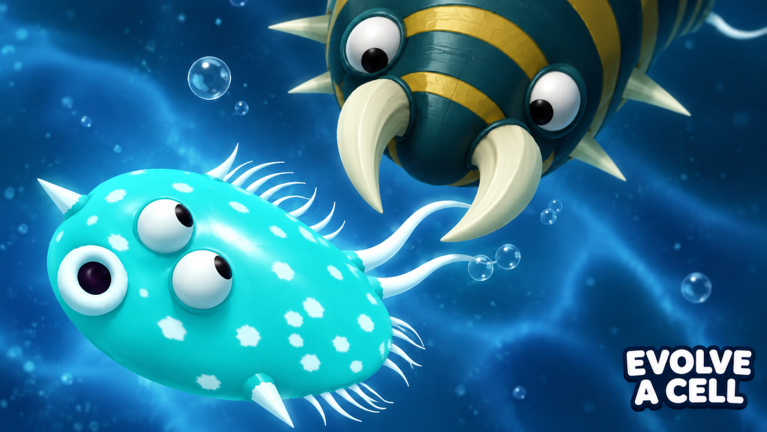
View reference image
On this page
Your first objective is a repeatable life
A useful first session in Evolve a Cell ends with more understanding, not necessarily the largest creature in the pond. You should know which food your current cell uses, how to leave an unwanted encounter, where upgrades appear, and what the game asks before the next progression step. That makes the next life easier even if this one ends early.
The official Roblox description establishes the core loop: feeding, hunting, adding parts, customizing a creature and eventually challenging giant bosses. It does not supply a complete control chart or a guaranteed opening build. The route below combines those advertised features with dated footage and practical planning. It is not presented as our own in-game test.
1. Read the diet choice before you move
The October 14 gameplay guide from AllThingsHow describes an opening diet choice. In that recorded version, meat goes with jaws and red food, while plants go with a filter mouth and green food. Check your current prompt rather than assuming that every visible orb serves the same purpose.
Choose one food route you can recognize. You do not need to settle an endgame build at the first screen. The immediate question is whether you can identify food that advances your current cell without crossing a threatening creature’s path. After eating, look for the corresponding progress change. An attractive object that produces no useful change may not be the right target for your current diet or objective.
If you are unsure, stop adding new variables. Try one nearby food type, watch the HUD, and compare. Changing diet assumptions, movement, targets and upgrades together makes it much harder to understand why progress improved or stopped.
2. Use the opening shield to learn, not to wander
The same dated guide reports a three-minute newbie shield, and its linked gameplay frame visibly shows a shield notice. Treat the protection displayed in your own game as the rule. Do not rely on an old duration after an update, and do not assume protection covers every hazard merely because it prevents another cell from eating you.
While the notice is active, practice a small loop: approach suitable food, turn away, and return through an open route. Notice how much space a full turn needs. Identify an area where you can change direction without immediately meeting a bigger creature. Collecting while practicing is more useful than spending the whole window traveling toward something spectacular in the distance.
Before the shield ends, look outward. A route that was harmless while protected may now pass through a predator’s path. Leave enough space to choose a different direction. This is a planning recommendation, not a claim that a particular map edge or landmark guarantees safety.
3. Learn movement before taking a fight
The linked October gameplay shows Space as a dash input on desktop. Use the control prompt for your device; this is not a verified mobile or controller mapping. Practice one dash where failure will not immediately place you in contact with a threat. Learn the distance you actually travel and what the current HUD says about another use.
Do not build a chase around an escape action you have never tried. A target can lead you into other cells, and a successful first bite does not settle the entire encounter. Before committing, identify the direction you will take if another creature arrives. If you cannot name an exit, collecting elsewhere is a reasonable choice.
Size is useful visual information, but it is not a published damage formula. A smaller-looking opponent can have parts or effects you have not learned. Start by watching unfamiliar creatures from outside contact range rather than using your current life to test every unknown interaction.
4. Spend to fix the problem you actually have
Bax’s October 11 session shows repeated creature edits and decisions about movement, vision and offensive parts. The useful lesson is that a creature can be revised around a problem. It does not establish that copying the final arrangement will work for every player or later update.
After an upgrade appears, ask what prevented progress during the previous few minutes. If you could reach food but struggled to turn away, inspect choices related to turning or movement. If you survived encounters but spent most of the session recovering, inspect the current recovery descriptions. If you could not finish a chosen hunt, inspect the relevant attack options before assuming you need a completely different creature.
Change a small amount, then return to a familiar situation. You can learn more from a modest improvement you understand than from equipping several unfamiliar parts at once. Keep visual customization separate from demonstrated stat changes: the official listing permits shaping and painting, but a dramatic appearance is not evidence of a combat bonus.
For a more detailed comparison process, use the evolution parts guide.
5. Pick one small checkpoint at a time
A beginner checkpoint should be recognizable without a spreadsheet. Examples include completing a food loop without being pursued, surviving an encounter by leaving early, or making one useful body edit. These are suggested learning goals, not official stages or unlock requirements.
After reaching one checkpoint, read the game’s next instruction. A progression prompt may ask for an action that extra feeding alone cannot resolve. Do not convert an unfamiliar word into a guessed boss location or an invented level threshold. Record the wording, inspect the relevant menu, and check whether you have an unclaimed or unfinished choice.
If your food route is reliable but the progress bar stalls, the feeding and growth guide helps separate food problems from progression gates. That distinction prevents a common waste of time: doing a familiar action repeatedly because it used to work, without noticing that the objective changed.
6. Read the death screen before choosing
A death can end a useful experiment without making the whole session useless. First identify what happened: did you chase too long, miss a new threat, open a menu in a risky situation, or choose an interaction you did not understand? Carry that explanation into the next attempt.
Dated October coverage shows different continuation choices, including a descendant option, a fresh start and a paid second chance. Their current text matters more than a summary here. Read exactly what would be kept, lost or charged before accepting. This guide does not promise that any particular resource or build always survives a reset.
If the interface offers a purchase, pause long enough to decide whether it solves a problem you understand. Repeating an avoidable opening mistake with a paid revive does not teach the escape route. You can choose to learn the route first and revisit spending later.
A compact first-life review
Before leaving the session, answer four questions in plain language. Which food advanced your current cell? What was the clearest warning of danger? Which upgrade solved a visible problem? What will you do differently at the next spawn? A short answer to each is more actionable than remembering only the largest creature that defeated you.
The exact game remains Evolve a Cell by Splitline: Creative, root place 75545101555306. Older footage can help you recognize systems, but your current prompts decide the active rules. Return to the guide hub when your next task changes from surviving to building or feeding efficiently.
Step-by-step guide
- Check your first prompt
Confirm the diet and food cues on your screen, then find a short collection route before approaching a larger cell.
- Turn protection into preparation
When a newbie shield is displayed, collect food and learn your movement. Leave yourself room to turn when the protection ends.
- Solve one problem with each upgrade
Choose an upgrade because it fixes a visible issue such as slow turning or poor recovery, then observe the difference before changing everything.
- Review a death before restarting
Read what each continuation option retains. Decide whether to continue or reset only after identifying why the previous life ended.
Quick reference
Decision reference
Official facts and dated observations are identified in the text below.
| Situation or system | Action or meaning | Limit or check |
|---|---|---|
| You need food | Collect nearby food matching your current diet | Do not chase a stronger cell just because it is close |
| You are being pursued | Move toward open turning space and avoid a dead end | Do not stop to redesign while danger is unresolved |
| You reached an upgrade | Read the actual card and choose for the current bottleneck | Do not copy unverified percentages from an older guide |
| You died | Read the current continuation choices | Do not assume a reset preserves every system |
Video evidence
Watch creator walkthroughs alongside this guide. Check the recording date before following requirements that may have changed.
Evolve A Cell GUIDE! (Best Upgrades, Mutations, Tips & Tricks) ROBLOX
The linked gameplay is the source of the visible shield and diet frames cited by the October 14 secondary guide. These frames are reference evidence, not our own playtest.
Upgrading The STRONGEST Cell in Evolve a Cell
An extended Evolve a Cell session showing creature edits, movement choices and repeated life decisions. Captions were collected; numerical claims remain version-specific.
FAQ
Can I eat other players in Evolve a Cell?
Yes. The official listing includes hunting other cells, explicitly including players. That confirms the option, not a safe target size or a guaranteed win.
Does the beginner shield last exactly three minutes?
The October 14 gameplay guide reports a three-minute shield, and its linked frame shows the shield active. Check your own countdown; protection duration and behavior can change.
Sources
Recheck these links whenever the game version, release status, or strategy changes.
- Official Roblox experience Evolve a Cell by Splitline: Creative; official advertised systems checked 2026-10-15.
- Official Roblox game metadata Universe identity, root place and creator binding; live counts are not treated as fixed facts.
- October 14 gameplay guide with timestamped UI references Secondary observations: diet, shield, upgrades and continuation choices. Current in-game prompts take precedence.
- ItsChalls gameplay · 2026-10-13 The linked gameplay is the source of the visible shield and diet frames cited by the October 14 secondary guide. These frames are reference evidence, not our own playtest.
- Bax gameplay · 2026-10-11 An extended Evolve a Cell session showing creature edits, movement choices and repeated life decisions. Captions were collected; numerical claims remain version-specific.